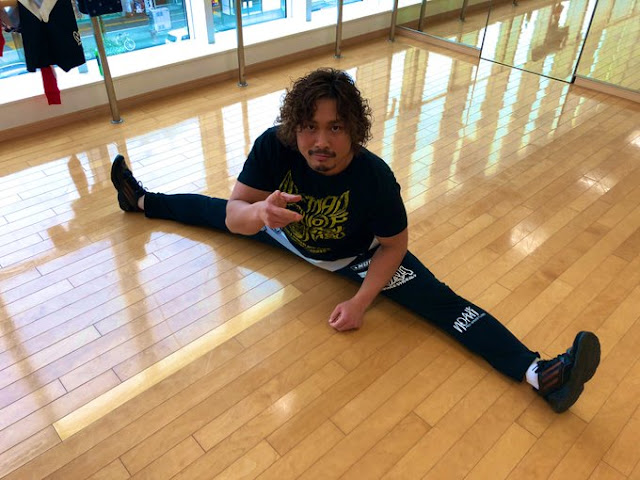
"Misawa-ism" remains: how is Katsuhiko Nakajima looking at Noah?

July 15th 2017
Nikkan-Spa
"How can I avoid this?"
Lost in the cheering, there was a customer shouting this. In the overcrowded venue, a frosty air drifted. On June 4th at Korakuen Hall, Katsuhiko Nakajima had just made his fifth defense against Mohammed Yone, where he did not fall to his special move, the Kin Meat Buster.
Mitsuharu Misawa, who founded Noah, was called "a receptive genius". Any skill he could win with. The fan who loves Misawa's wrestling, still supports Noah. Mitsuharu Misawa, Naomichi Marufuji, Go Shiozaki, who was Misawa's last tag partner before he died...amongst those wrestlers who shared the inheritance of Misawa, some fans do not accept Nakajima, who joined Noah last year.
"How can I avoid this?" - this single sentence cried out by a fan seemed to be something significiant. My chest tightened and I felt superimposed on myself.
"You don't understand wrestling"
I remembered the critizism.
(Interview by Takagi Shingo)
Q: You made your debut at 15 years and 9 months, the youngest in history?
NAKAJIMA: It is an honor, and I am happy. Takagi debuted in the same year and is an athlete who has stimulated me. I have also wrestled in Dragon Gate, and when I was at Kensuke Office, I did singles matches at Korakuen Hall since then.
Q: Korakuen Hall on the 4th June was awesome. Misawa's memorial ceremony was also impressive. You refused to accept Mohammed Yone's Kin Meat Buster?
NAKAJIMA: Because if I took it, I would have lost (laughs)

Q: As with any technique, there are wrestlers who can take it.
NAKAJIMA: If I wanted do, I would have taken it, but the Kin Meat Buster is a dangerous technique and it is also his best skill. I didn't think he wanted to take my vertical spike. After recieving it, there is a possibility that the match would have ended.
Q: How do you view Misawaism as his being a "Receptive Genius" as a Noah wrestler?
NAKAJIMA: Since I entered Noah two years ago, like Marufuji and Shiozaki I cannot speak of any "Misawaism". I had two single matches with Misawa, and I feel that I have learned a lot about the depth of professional wrestling.
Q: What did you feel when you were at the memorial ceremony?
NAKAJIMA: As I am carrying Misawa's belt, I felt the importance of it.
Q: After capturing the belt last October, what went through your mind?
NAKAJIMA: I feel that I have raised Noah and made it stronger. I am now on my sixth defense, but I think with each defence, "NOAH THE REBORN" has risen. It is regeneration and I am looking to make a new one. The parent company also became new last November.
Q: As the company changed, did the wrestlers?

NAKAJIMA: The wrestlers have changed. Regarding entering the ring, nothing is shifting. Besides myself, everyone has the same pride of being in Noah.
Q: After last year, the Suzuki Army withdrew from Noah after two and a half years?
NAKAJIMA: Until now it was figured that everyone should work hard to defeat the Suzuki army. The army has gone now and the power of individuals is becoming noticable. We have returned to pure Noah.
Q: Has there been a change in audience?
NAKAJIMA: I think there has been. I think that people are most excited about Noah's future and I think there has been an anxiety factor. I want to strive to show a match that will dispel this.
Q: What was the anxiety factor?
NAKAJIMA: Simply put, we want to make sure that we do not betray customers. Of course, it does not respond to expectations, but beyond expectations. I think that Noah is such an organisation.
Q: Speaking of matches, you have a powerful kick? You have been doing Karate since the third grade of elementary school?
NAKAJIMA: I wanted to be strong. When I was in kindergarten, even if I lost a fight, I would cry when I came home. It was disapointing. At that time, my older brother was doing karate, so I told myself that I wanted to do it too and went to the dojo. Since then, I have not had a quarrell.
Q: You won the national competition when you were in the first grade of junior high?
NAKAJIMA: That was Kojin Kaikan in Tokyo. Various athletes from all over the country gathered. I was told that I was "extremely true", but I was not extreme. The competition was very real rules; full contact, hit with bare hands. There was face protection though.
Q: This bought you to the attention of Akira Maeda?

NAKAJIMA: I met Mr Maeda when I was in junior high. Back then I went to a fighting sports festival and Mr Maeda was the first to connect with me. In Yokohama I went to a Meet & Greet, and told him that I wanted to enter RINGS. He said "Take off your top and show me your back". I did and he told me to come.
Q: RINGS shut down?
NAKAJIMA: I was planning to enter when I graduated from Junior High, but that December, RINGS was dissolved. It was about fifteen years ago, I don't really remember.
Q: Did you like wrestling?
NAKAJIMA: I saw it several times. My karate teacher like pro-wrestling and went to see Noah. The teacher took us to see wrestling, and we had pictures taken with the wrestlers for the first 100 people. I thought they had awesome bodies, but I wasn't interested that much as I didn't really understand it.
Q: You were scouted by WJ Pro Wrestling when you were in the third grade, who were led by Riki Choshu, and you joined. That was a great decision for a High School Student?
NAKAJIMA: I always wanted to turn professional. When I went to High School, I wanted to earn money more than study. It was a single parent family (mother) and we were insanely poor. When I would come back from Karate, the house was dark because the electricity had been cut off. My mother came out of the back with the candle, and I almost ran off because I thought it was a ghost. I was very scared (laugh). It happened a few times and I got used to it, "oh, it looks like we ran out of electricity today". Because there was no gas, there was a cold water bath. Because there was no money, there was no dinner. There was no school lunch. Once a month I had a envelope at school. I had no paid school lunch. That's why I wanted to have this life for myself and my parents. It was better for me to go out to work and to earn money for three years than to go to High School.
Q: You did not think about getting a job?
NAKAJIMA: I didn't think of it. I only saw professionals. In Junior High School you have to enter into club activities. But I say I am going to see professionals, and I can't do them. My karate teacher called the principal directly. When school was over, I went to the dojo and practiced karate.
Q: Did you want to turn pro at Karate?

NAKAJIMA: At that time it was K1. Andy Hug, Ernesto Hoost, Mike Bernardo, Peter Aerts. They were the main axis and they looked so gorgeous. Andy Hug is a Kyokushin, but at 180 cm is very small in K1. Still, he won the Grand Prize with a small stature and I admired that and wanted to turn professional.
Q: When you joined WJ, you debuted in MMA fighting at X-1. You won via referee stop winning KO in 58 seconds. At that time, where you wrestling?
NAKAJIMA: I was doing exercises, but only passive ones. I think the practice for my wrestling debut was from then on. I told Mr. Chosu I was making costumes and I debuted in January the next year. My opponent was Tomohiro Ishii. I don't remember much, I was too nervous. I don't remember if I tried anything. I was desperate.
Q: WJ Wrestling folded in 2004, and you joined Kensuke Office. What made you choose them?
NAKAJIMA: Their exercise regime was the most severe. I didn't think it would be a mistake if I went to such a tough place. That was the only reason. I used to pick up their kids from Kindergarten, and after two and a half years of living together, we got on very well.
Q: I heard that it was a very tough place.
NAKAJIMA: It was tough. Privately it was excellent, but the work was hard both in practice and in courtesy. Courtesy was the hardest. I was instructed about angles, like how to bow. "Lower your head like this!"
Q: You were a fellow student of All Japan's Miyahara. What was he like?
NAKAJIMA: I was a junior to him. He was a hard worker. I remember taking notes. He was great, but I am not good at schedules. I decided things on the spot, and wasn't really used to it.
Q: You were with Kensuke Office from sixteen to twenty-seven. Why did you quit after 11 years?
NAKAJIMA: I thought it was part of me, and a place I chose. When it came down to it, Kensuke Office was really only a small group. There were about six wrestlers. So even if a show was planned, we all set up the ring. Because it was so small, there were things we shared.
Q: Why did you leave?
NAKAJIMA: I told him that I wanted to be independent, but I think I couldn't quit without his blessing.

NAKAJIMA: I faced Liger at New Japan at The Tokyo Dome. I debuted in 2004 and wrestled there in May, and I did not know the sie of the dome, and had never wrestled before so many people, so I had a very valuable experience. I ran down the ramp, and I lost my breath before the match.
Q: It is elite to be in the Tokyo Dome five months after the debut.
NAKAJIMA: It wasn't alwats elite. I was frustrated most of the time, and I was thinking about quitting pro-wrestling. When I was in the Kensuke Office I was struggling both physically and mentally, there were ten to fifteen matches a month. Wrestling was not as I expected. I had no belt or match progression.
Q: As well as New Japan you also went to All Japan and Noah?
NAKAJIMA: All Japan, Noah, DDT and Michinoku Pro. Most promotions. Zero-ONE. I also think I might have gone to Osaka Pro.
Q: Why did you decide to join Noah, as you had plenty of other options as a freelancer?
NAKAJIMA: Noah was the main fight during the second half of my time at Kensuke Office, and I had strong thoughts about Noah that were growing. I was already in BRAVE, and I was making friends. It was a fun place besides matches, and naturally I wanted to join Noah. So I asked.
Q: What was the situation of Noah then?
NAKAJIMA: It was 2015, the year the Suzuki Army arrived. In December I won against Shelton Benjamin. I went to Noah the following January. As a member of Noah the feeling got stronger. Even though it was another promotion (haha).
Q: What are your goals for the future?
NAKAJIMA: To excite Noah in any way. I think only of that.
Q: Do you feel excited?
NAKAJIMA: Based on what Noah wants to show, thats how it should be shaped. To not do this will make those watching lose track of it. I don't really know right now. The juniors are fine, but the heavyweights are unsure of what they want to show. I understand the title match and the other matches, but otherwise, what on earth do you want to show? I do not know. The company needs to have stem, its easier to see and express.
Q: Is there a dispute between units?
NAKAJIMA: I think the best thing would be to make the focus a generational change. I think that is the best thing that can be shown right now. In the meantime, even when defending, I commented "does the upper generation not turn around now?". Since the veterans are all great wrestlers, I think it would be good to stimulate things like this.
Q: What is good about Noah, and what is not?
NAKAJIMA: I think the good and the bad are equal. I think it is a promotion that can do better, and the wrestlers are high level, accomplished and the variety is rich. Noah should be able to go up further. I think that it will, and as one of the wrestlers, I want to do my utmost.
Q: What kind of wrestler do you want to be?
NAKAJIMA: I want to be a wrestler that can convey pain. Physical and mental. Wrestling is a wonderful place where you can convey this to people. I can express various frustrations, I can endure, I can express the process of returning. There are adults watching too, but it is children I want to see it. There are a lot of stories of being bullied, and I have experience of being bullied too.
When you hit, your hand hurts. I want to convey the person you beat has also hurt and there is pain on both sides. Wrestling can express both. Do you know pain? I think it would be nice to have a match to allow people to understand this, and that if more wrestlers do it, we can convey it from the ring.
Q: In this series we are exploring strength, but was is strength for you?
NAKAJIMA: Pain. I have been in pain since I was a kid. Because I was poor, I saw everything around me. When it rains everyone went to the dojo by car, I had only a bicycle, even during the typhoon. The pain of being beaten, the pain of being frustrated, this can all become stronger when you can pass it. Strength is that, and is not limited to just wrestlers, it is for any person.
Q: Who do you think is the strongest wrestler?
NAKAJIMA: Speaking of the strongest, it would be the first Tiger Mask, Satoru Sayama. He is a living legend. He was in the fourth match of my debut at Korakuen. His top rope entrance was really cool.
Q: Thank you very much
Link to original article from Nikkan-Spa (in Japanese)

Comments
Post a Comment
Spam will be deleted immediately